Latest
Agentic Peak Strategy – What to Do Differently This Peak?

Search is evolving and as more shoppers turn to AI assistants to help guide them through their online journeys, as marketers, it’s important to consider how to use these systems to ensure you have a successful Peak.
Join us in our latest webinar series as we explain how our Productcaster experts can help you prepare for the new normal, this year.
Is this really going to be an agentic Peak?
In January, Retail Week reported that:
Referral traffic to retail sites from AI agents grew +329%, according to data from Adobe
Boxing Day saw the sharpest spike, as shoppers turn to conversational search to answer their questions and find the best bargains.
AI-referred traffic jumped +685% year-over-year
Google reported that search interest in AI shopping rose tenfold in 2025 compared to 2024.
What does this mean?
This clearly demonstrates a strong growth trajectory, and as consumers become more comfortable with using AI to do their shopping for them, it’s not unrealistic to expect this growth to continue as the technology continues to develop. AI assistants already support agentic browsing, effectively acting as a personalised shopping assistant, and allowing them to complete the entire customer journey. It’s no longer just the initial search, but the complete customer journey from discovery to purchase.
How’s Peak looking this year for retailers?
Economic factors are starting to see slight improvements; this is despite continued tension in the Middle East. Much of this renewed optimism has been driven by a combination of a few specific factors, including the ‘Burnham Bounce’, World Cup and a strong summer, with overall better weather. As a result, households’ view of the economy is the strongest it’s been since 2024.
Is this likely to continue in 2026?
Cost of living will naturally influence people’s sentiment, so whether this continues or not will rely heavily on Burnham’s Government promises around this, and sustainable, economic growth. If these don’t align, then consumers may be deterred from heavy spending over the holidays.
The way people search and shop is changing
Things have come a long way since Amazon revolutionised shopping in 1998. Although none of us can see into the future, with the data that’s available today, and continued investment from Big Tech into LLMs, it’s not unrealistic to expect that we’ll see more growth in agentic commerce. Perhaps, surpassing last year’s figures.
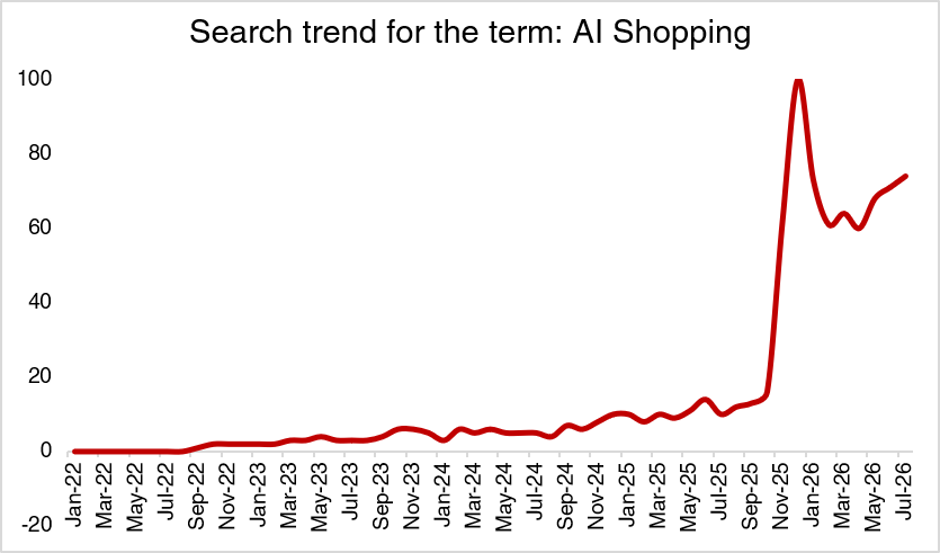
As we can see looking at the Trend data above, last year, we started to see interest in AI shopping rise towards the end of Q3, with activity peaking at the end of the year, and December seeing triple digit growth. Crucially, we can also see that interest has remained high up to the present day, being considerably higher than it was in July, only a year ago.
Browsing is becoming conversational
Agentic search allows shoppers to be very specific, and LLMs are getting better at surfacing the most relevant results, tailored for a user’s specific request.
What is Universal Commerce Protocol?
Universal Commerce Protocol (UCP) is designed to provide a common language for AI agents and commerce platforms. The protocol could enable Google to facilitate transactions while the retailer remains the seller of record. Although not yet live in the UK, it is also intended to support purchases directly within experiences, such as AI Mode and Gemini, all with the necessary infrastructure integrated into the experience.
Positive AI sentiment is highest among the younger demographic
Initially, work-related questions dominated ChatGPT, but by June 2025, 73% of queries were non-work related. The data also shows that younger people are more excited about AI (48% of 25 – 34-year-olds, compared to 31% of people over 51-years-old).
We can expect the number of active AI users to increase over the next couple of years as younger shoppers gain access to more disposable income.
Get your foundations right
Focus on getting the basics right first as they still form the foundation, and AI agents can’t surface you properly if your house isn’t in order. Consider:
Titles and description – AI agents use these to understand and categorise your product, along with comparing it to competitors, and properly structured, optimised content improves relevance
Product reviews build trust for both agents and shoppers, giving them clear reasons to take actions, and they can clearly highlight USPs and benefits
All your data must be accurate, critically, the price, shipping and return details, because agents will use the data to present a complete offer, which both shoppers and LLMs need to have confidence in
Clean product images help to drive conversion, and visuals are used to contextualise recommendations
GTIN – the foundation of product identity, this must be valid and it helps Google match and consolidate your product across different surfaces
How to have a successful agentic Peak?
Ensuring that you’re prepared for agentic Peak means that your visibility depends on your overall AI readiness, so this means:
No more keyword stuffing in the feed – high quality, optimised feeds containing all foundational and conversational attributes. Fix those brilliant basics first
Ensure your site has rich meta data that defines specific attributes and use cases clearly
Keep your feed up to date to maximise inventory and get the most out of each investment
Get control of search volumes during Peak before they become a problem
Adapt your images and ad copy for the people that are using AI the most
Adopt UCP so you are ready for native commerce and conversational queries
Build trust with high-resolution images and verified customer reviews
Protect Brand traffic, use guardrails such as URL exclusions and monitor search terms closely – don’t just let the AI run free, it still needs managing effectively by a human expert
Employ accurate data measurement and reporting – knowing where your traffic and sales are coming from is vital to maximise performance
Test your inventory early, to scale profitable SKUs ahead of Peak
Review your first-party data and use it wisely in line with your Peak strategy
Testing and measuring frameworks effectively
Taking the mindset of test and learn is important in any marketing discipline, but especially with AI and LLMs, because the technology is new, and it’s evolving at a rapid pace. This is the time to double down on testing as much as possible, so you can get enough data to help you make more informed decisions in the future.
As long as your test results in data that shows if something did or didn’t work, and how you can tweak things moving forward, it’s valuable.
That said, there are things you want to make sure you’re doing right at a basic level.
Feed hygiene – making sure that you’re visible</h3
Ensure that nothing is being blocked by robots.txt and if needed, check with the SEO team. Make sure that AI agents can parse the page and it matches user intent
New attributed integration – feed maturity
Review coverage, including your shipping and returns information, and ensure accuracy and consistency
Measurement
Just because attribution may prove challenging, we still need to get the most out of LLMs and track results effectively
Integrate tracking parameters for referral traffic into dashboards
Consider the % traffic shift in your reporting
Feed based A/B traffic splits
UCP tracking when no live Session is on site
Organisation
Effective collaboration between both paid media and SEO teams is required to ensure that LLMs can access everything they need to, and results are being tracked appropriately, including Governance of feed and on-site information
Reporting capabilities are in place and all relevant partners are kept up to date
Include direct plug ins for AI attributes at source level
Budget with acceptance of light reporting visibility
How can we help you prepare for agentic Peak?
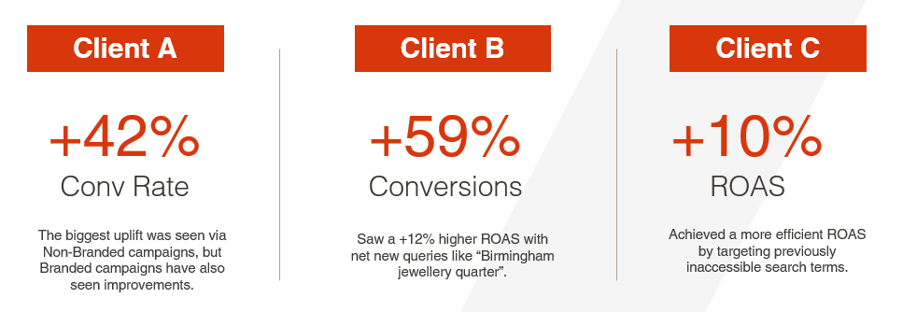
Here at Productcaster, we have a dedicated and friendly team of experts on hand that are equipped with the knowledge and expertise to make sure you’re getting the most out of every penny and taking advantage of this new landscape. Our results speak for themselves. Get in touch with the team today to see how we can help you.
Watch the full webinar:
Ready to switch? Let’s get started.
Book a Demo